Introduction
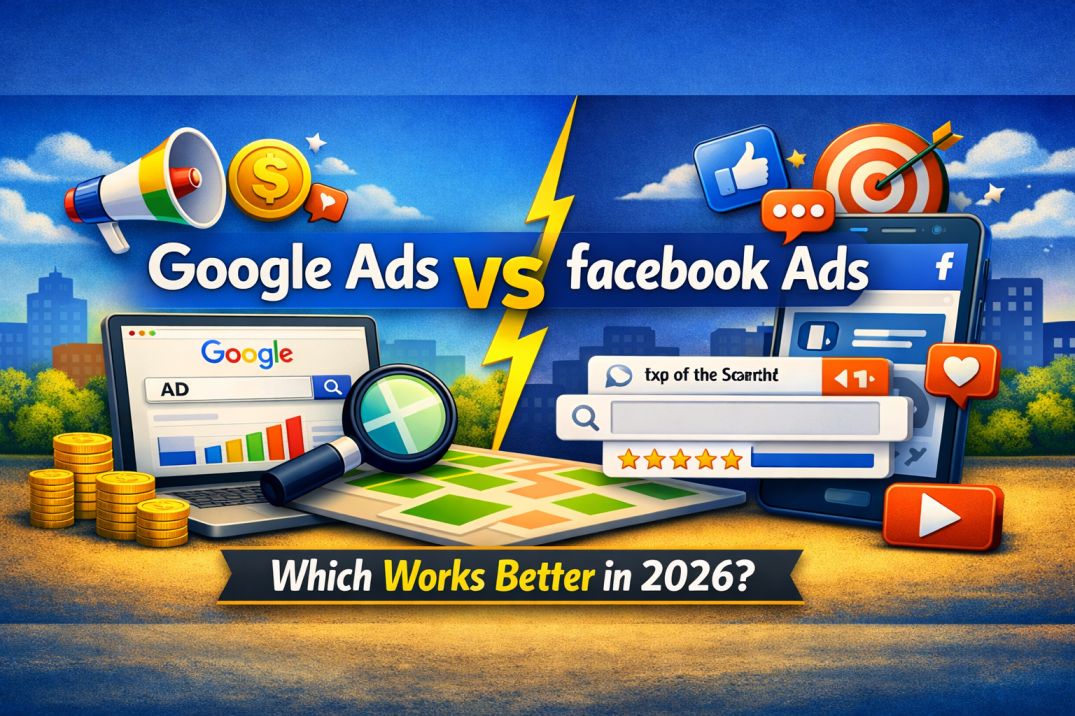
Every business with a marketing budget eventually asks the same question: should this money go into Google Ads or Facebook Ads? Both platforms dominate digital advertising, both promise measurable ROI, and both can drain a budget quickly if used without a clear strategy. The honest answer isn't that one platform is universally better; it's that each is built for a different moment in the customer journey. Understanding that difference is the key to spending your ad budget where it will actually convert, rather than where it simply gets clicks.
Budgets Split Without a Strategy
Many small and mid-sized businesses split their ad spend evenly between Google and Facebook without understanding why. This often leads to wasted spend, mismatched creative, and confusing performance data that makes it hard to tell what's actually working. Google Ads campaigns built with Facebook-style broad targeting underperform, and Facebook campaigns built like search ads, plain, text-heavy, sales-first, fail to capture attention in a social feed. The problem isn't the platforms themselves; it's applying the wrong logic to each one.
Matching Platform to Intent
The real solution is understanding that Google Ads captures existing demand while Facebook Ads creates new demand. Someone searching "affordable interior designer in Chennai" on Google already knows what they want; they're evaluating options and ready to act. Someone scrolling Facebook or Instagram wasn't looking for an interior designer at that moment, but a well-placed, visually compelling ad can introduce the need and spark interest. Once you separate these two functions, budget allocation and campaign design become far more effective.
Key Features of Each Platform
Google Ads: Capturing Intent. Google Ads operates on a search and display network built around keywords. Campaigns include Search Ads (text-based, triggered by search queries), Shopping Ads (product listings for e-commerce), Display Ads (visual banners across partner websites), and YouTube Ads (video-based). The core strength is intent: you're reaching people at the exact moment they're actively searching for a solution.
Facebook Ads: Building Demand. Facebook Ads (which includes Instagram placements through Meta's ad platform) operates on demographic, interest, and behavior-based targeting rather than search intent. Formats include image ads, video ads, carousel ads, collection ads, and lead generation forms. The core strength is discovery: reaching people who fit your ideal customer profile before they've started actively searching, often through visually engaging or story-driven creative.
Targeting Precision: Google Ads targets based on what people are typing into the search bar right now. Facebook Ads targets based on who people are, their age, interests, behaviors, life events, and connections. Both are precise, but in fundamentally different dimensions.
Cost Structure: Both platforms use auction-based, pay-per-click or pay-per-impression models, but costs vary significantly by industry and competition. Highly competitive Google keywords in sectors like legal services or insurance can carry a high cost per click, while Facebook's cost per impression is often lower but requires more creative testing to find what converts.
Funnel Stage: Google Ads is generally strongest at the bottom of the funnel, where the customer is close to a purchase decision. Facebook Ads is generally strongest at the top and middle of the funnel, building awareness and consideration before the customer starts actively searching.
Benefits of Each Platform
Google Ads delivers high purchase intent, measurable and direct ROI tracking, and strong performance for time-sensitive or local service searches. Facebook Ads delivers cost-effective reach at scale, rich visual storytelling that builds brand affinity, and highly specific audience targeting based on interests and behaviors that search platforms can't replicate. Used together, they reinforce each other: Facebook builds awareness and warms up an audience, while Google captures that same audience when they later search with intent to buy.
Google Ads vs Facebook Ads: Side-by-Side Comparison
| Aspect | Google Ads | Facebook Ads |
|---|---|---|
| Primary Strength | Capturing existing search intent | Creating demand and awareness |
| Targeting Basis | Keywords and search queries | Demographics, interests, behavior |
| Best Funnel Stage | Bottom of funnel (ready to buy) | Top and middle of funnel (awareness) |
| Ad Formats | Search, Shopping, Display, YouTube | Image, Video, Carousel, Collection, Lead Forms |
| Typical Use Case | Local services, e-commerce, urgent needs | Brand building, product discovery, retargeting |
| Cost Driver | Keyword competitiveness | Audience size and creative performance |
| Reporting Strength | Direct conversion and search term data | Engagement, reach, and audience insights |
Who Should Use Which Platform
Businesses offering services people actively search for- plumbers, lawyers, clinics, real estate agents- are usually better served leading with Google Ads, since capturing that ready-to-buy search intent delivers faster, more direct returns. Businesses with visually appealing products, lifestyle brands, fashion, home décor, food and beverage, or businesses trying to build awareness for a newer or less-searched offering often see stronger early results from Facebook Ads. Most established businesses, however, benefit from running both in a coordinated strategy rather than choosing one exclusively.
How BMax Digital Helps
At BMax Digital, we don't run Google Ads and Facebook Ads campaigns in isolation; we design them to work together. This starts with mapping your customer journey to understand where search intent exists versus where awareness needs to be built, followed by platform-specific creative and copy that matches how people actually behave on each channel. We set up proper conversion tracking across both platforms so you can see real performance data rather than vanity metrics, and we continuously test and reallocate budget toward whichever channel is delivering the strongest return for your specific business and industry.
Case Study: Balancing Both Platforms for a Retail Client
A retail client came to us running Facebook Ads exclusively, generating decent engagement but inconsistent sales. After auditing their funnel, we introduced Google Shopping and Search campaigns targeting high-intent product searches while shifting Facebook's role toward retargeting website visitors and building lookalike audiences from past customers. Within a few months, the combined approach produced a noticeably higher return on ad spend than either platform had delivered alone, with Google capturing the sales that Facebook's awareness campaigns had originally generated interest for.
Conclusion
There's no universal winner between Google Ads and Facebook Ads; each platform serves a distinct role in a complete marketing strategy. Google Ads excels at capturing people who are already searching for what you offer, while Facebook Ads excels at building awareness and demand among people who haven't started searching yet. The businesses that get the best results in 2026 aren't the ones that pick a side; they're the ones that use both platforms strategically, aligned to where their customers actually are in the buying journey. If you want a paid advertising strategy built around your specific business rather than a one-size-fits-all approach, talk to our team at BMax Digital.
Frequently Asked Questions
1. Which platform gives faster results, Google Ads or Facebook Ads? Google Ads typically delivers faster measurable results for businesses with clear search demand, since it targets people already looking to buy. Facebook Ads often takes longer to optimize because it requires testing creative and audiences before performance stabilizes.
2. Is Facebook Ads still effective in 2026 given rising costs? Yes, though costs have increased industry-wide, Facebook Ads remains effective when paired with strong creative, precise audience segmentation, and clear retargeting strategies rather than broad, unfocused campaigns.
3. Can a small business afford to run both platforms? Yes, many small businesses run both with modest budgets by starting focused, one or two campaigns per platform, and scaling whichever channel proves more profitable before expanding further.
4. Do Google Ads and Facebook Ads use the same keywords or targeting? No. Google Ads relies on keyword targeting based on search queries, while Facebook Ads relies on audience targeting based on demographics, interests, and behaviors; they require separate strategies.
5. Which platform is better for B2B businesses? Google Ads often performs better for B2B businesses due to the higher search intent behind B2B queries, though Facebook and LinkedIn Ads can be effective for building awareness among decision-makers earlier in the buying cycle.




Leave a Comment